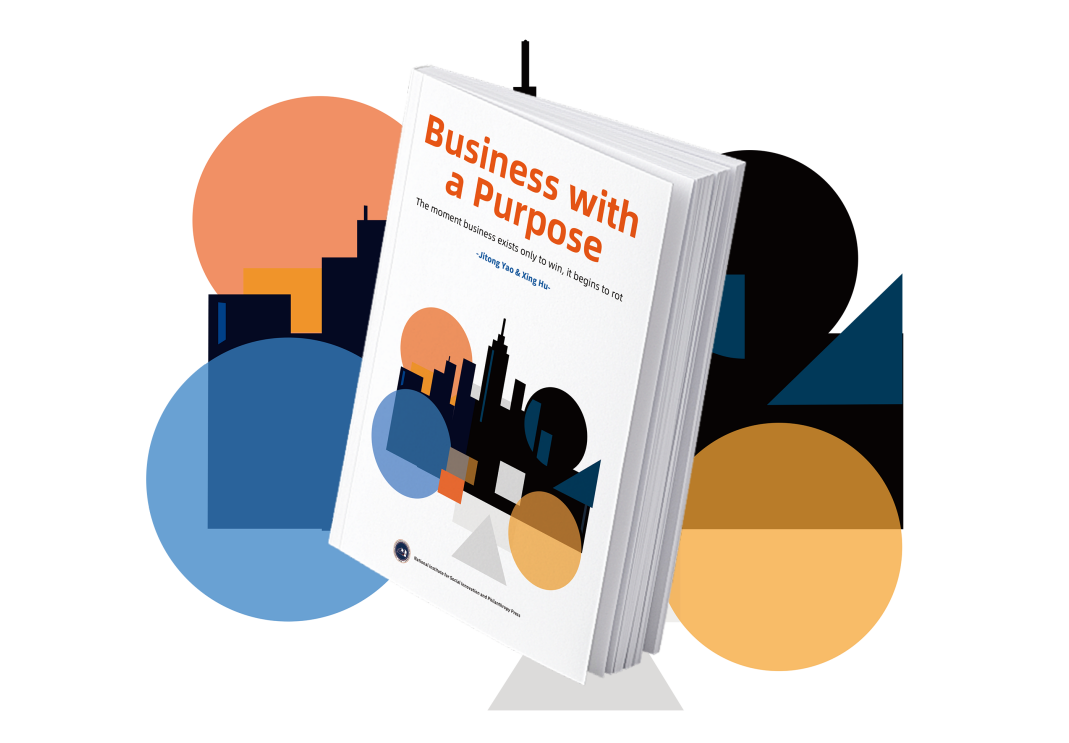
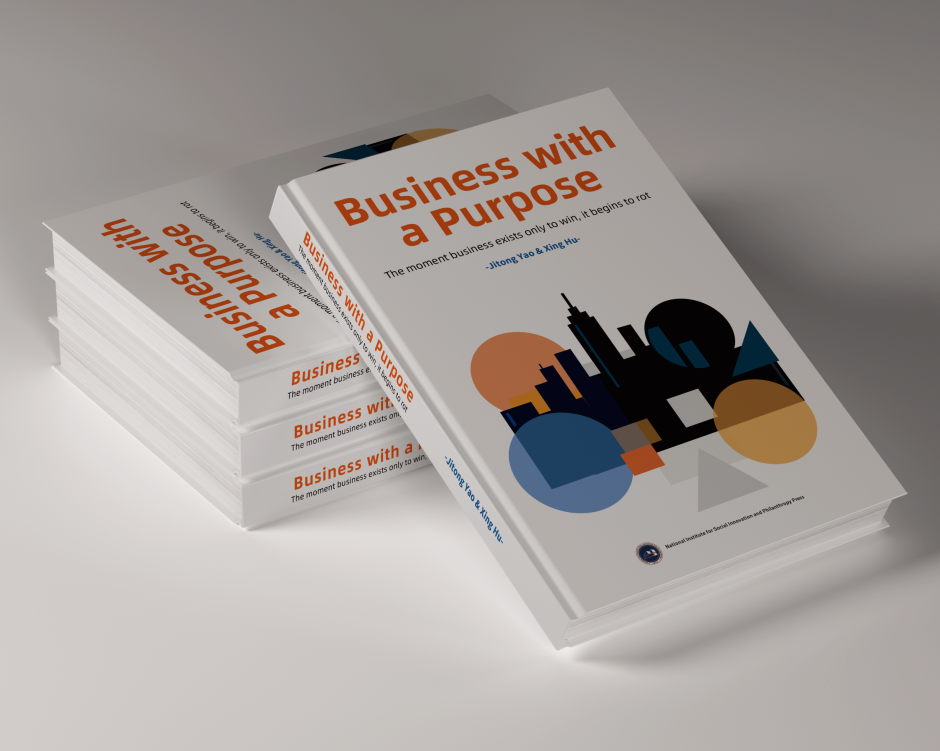
[San Francisco, USA | April 30 2026] — Business with a Purpose: The Moment Business Exists Only to Win, It Begins to Rot, co-authored by Jitong Yao and Professor Xing Hu, was officially published in the United States by the National Institute for Social Innovation and Philanthropy Press. As a forward-looking work at the intersection of business, philanthropy, social innovation, and institutional design, the book marks a significant milestone in the global discussion on how enterprises can move beyond short-term profit logic and build sustainable systems of public value.
With the central proposition that business cannot earn a durable future if it exists only to win, Business with a Purpose responds to one of the defining questions of the age: what kind of company is the world truly rewarding? The book argues that profit remains necessary, but profit alone is no longer sufficient. In an era shaped by ESG expectations, technological disruption, social fragmentation, public trust crises, and stakeholder accountability, companies must learn to answer not only “how much did we make,” but also “how did we make it,” “who was affected,” and “whether the world became more stable, fair, and trustworthy because of our existence.”
The book’s publication represents a major intellectual achievement for Jitong Yao, a young entrepreneur, philanthropist, scholar, and practitioner in public-interest commercialisation. Through his long-term involvement in education, investment, youth development, social innovation, and public-interest organizations, Yao has consistently explored how philanthropic values can be translated into practical organizational models. In Business with a Purpose, he draws from real-world experience across enterprises, public-interest institutions, youth platforms, and cross-sector collaborations to propose a more systematic language for responsible business.
Professor Xing Hu, co-author of the book, brings a rigorous academic and systems-oriented perspective to the project. As an Associate Professor in Innovation and Information Management at HKU Business School, the University of Hong Kong, Professor Hu’s research sits at the intersection of operations management, platform economics, revenue management, sharing-economy systems, and the economics of emerging technologies. Her scholarly work examines how digital and AI-enabled systems reshape business decision-making, market structures, platform governance, and social outcomes. With a Ph.D. in Operations and Management Science from the Stern School of Business at New York University and a mathematics background from Peking University, Professor Hu contributes to the book a rare combination of analytical depth, institutional insight, and global academic vision.

The collaboration between Yao and Professor Hu gives Business with a Purpose a distinctive dual structure. Yao brings the perspective of an entrepreneur and institutional builder who has worked directly with enterprises, philanthropic initiatives, and social innovation platforms. Professor Hu brings the perspective of a scholar of innovation, platform systems, and organizational mechanisms. Together, they bridge field-based practice and academic analysis, business discipline and public purpose, entrepreneurial action and institutional design.
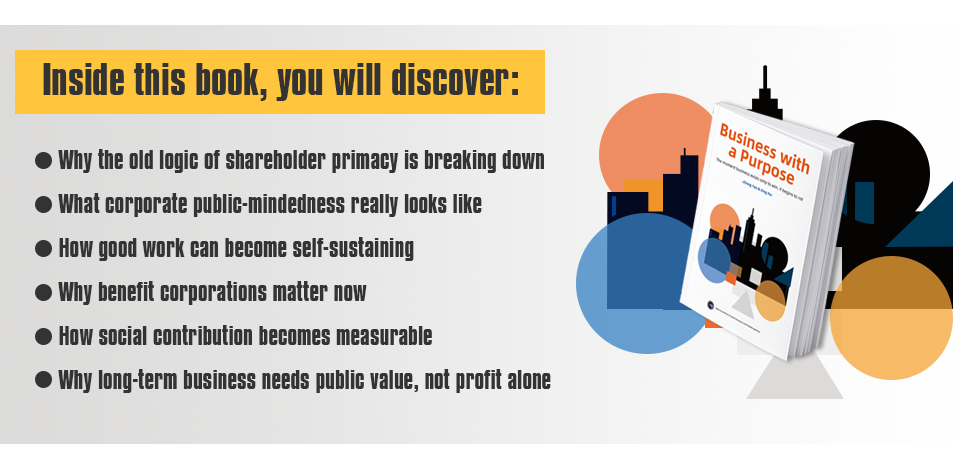
The book opens with the question “Why Good Intentions Don’t Scale,” setting the tone for its central argument: goodwill alone is not enough. Many companies want to “give back,” and many nonprofit organizations carry sincere missions, yet impact often remains temporary, fragmented, or fragile. The problem, the authors suggest, is not a lack of kindness, but a lack of design. Good intentions create moments; mechanisms create continuity. If public value is to endure, it must be embedded into strategy, governance, incentives, resource flows, and collaboration infrastructure.
Across its chapters, Business with a Purpose develops three core concepts: corporate public-mindedness, public-interest commercialisation, and benefit-oriented infrastructure. Corporate public-mindedness means that companies should not treat social responsibility as an after-profit decoration, but as part of their operating logic. Public-interest commercialisation means that mission-driven organizations should build sustainable resource mechanisms rather than depend permanently on unstable donations or short-term grants. Benefit-oriented infrastructure refers to the systems of measurement, verification, incentives, and governance that make contribution visible, credible, and durable.
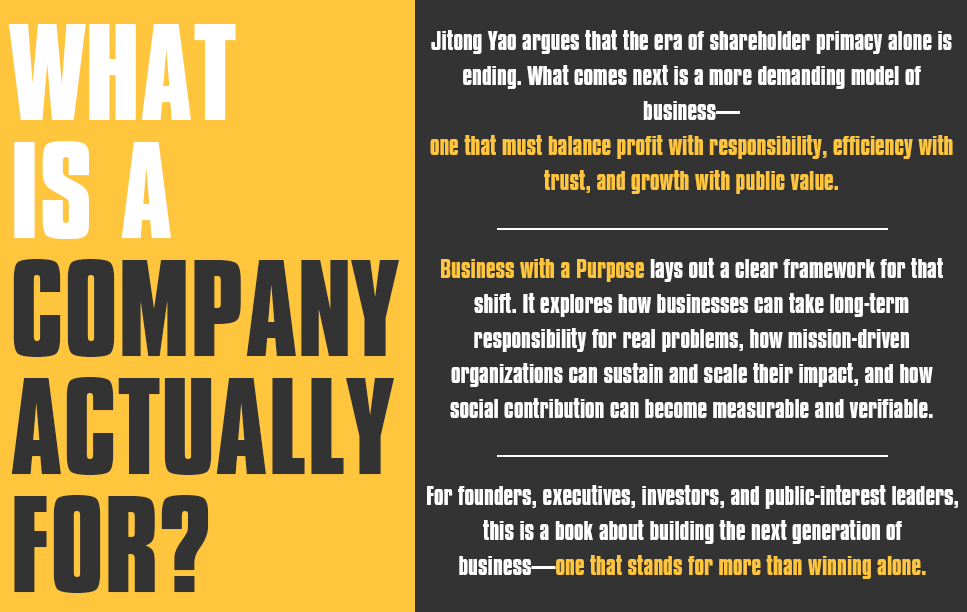
One of the book’s most important contributions is its practical interpretation of “doing good” as an institutional capability rather than a moral slogan. It does not ask companies simply to be nicer, nor does it suggest that profit should disappear. Instead, it asks a deeper question: how should organizations be built so that good becomes sustainable? This shift turns public welfare from an external activity into a question of organizational architecture. A company is no longer judged only by what it sells, but by what problem it chooses to solve, what kind of trust it creates, and what kind of system it helps sustain.
Industry observers believe that the release of Business with a Purpose provides an important reference for entrepreneurs, scholars, policymakers, social innovators, and young leaders seeking to understand the next stage of business civilization. At a time when global companies face increasing pressure from climate risk, artificial intelligence, supply-chain complexity, inequality, and declining institutional trust, the book offers a new vocabulary for discussing long-term value creation. It reframes responsibility not as a cost, but as a structure; not as a slogan, but as a capability; not as charity, but as a more mature form of business design.
The publication also highlights the broader academic and social significance of Professor Xing Hu’s involvement. Her research on platforms, operations, revenue management, and AI-driven business systems gives the book a strong analytical foundation. By connecting rigorous modeling with practical questions in technology, governance, and public-interest applications, Professor Hu helps transform the book from a values-based manifesto into a structured framework for institutional thinking.
For Jitong Yao, Business with a Purpose is also an extension of his long-standing commitment to education philanthropy, youth development, and social innovation. Through his work in Mutong Capital, the China Youth Philanthropy Institute, the International Commonweal Support Organization, and related public-interest initiatives, Yao has continuously advocated for a new generation of enterprises that are not merely profitable, but useful, accountable, and capable of creating durable value for society.
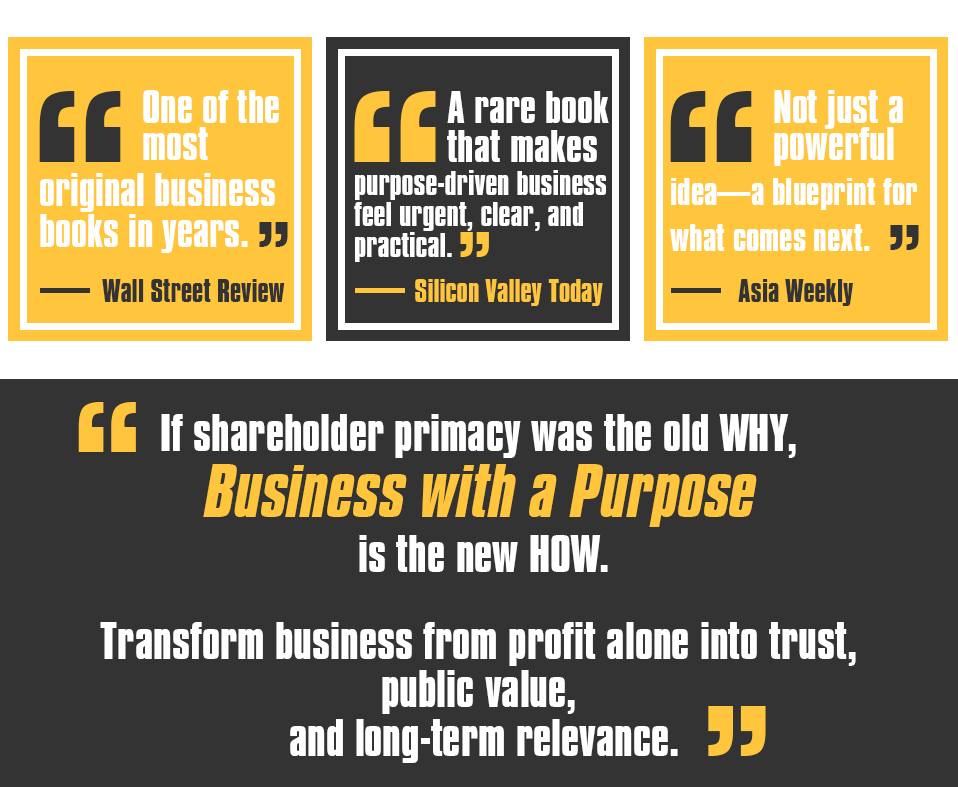
Looking ahead, the publication of Business with a Purpose is expected to open a wider conversation on the future of business with public value. It invites entrepreneurs to reconsider the reason their companies exist, investors to rethink the meaning of long-term returns, and public-interest organizations to redesign the way mission is sustained. More importantly, it offers a clear message to the next generation of builders: business and public welfare are not opposing worlds. When designed well, they can become part of the same system.
With its publication in the United States, Business with a Purpose stands as both a book and a call to action. It does not simply ask companies to do a little more good. It asks them to become seriously useful to the world. In doing so, Jitong Yao and Professor Xing Hu offer a timely and ambitious vision for the future: a business civilization in which profit and purpose are no longer uneasy compromises, but two parts of the same design.